CUDA 内核CUDA Kernel
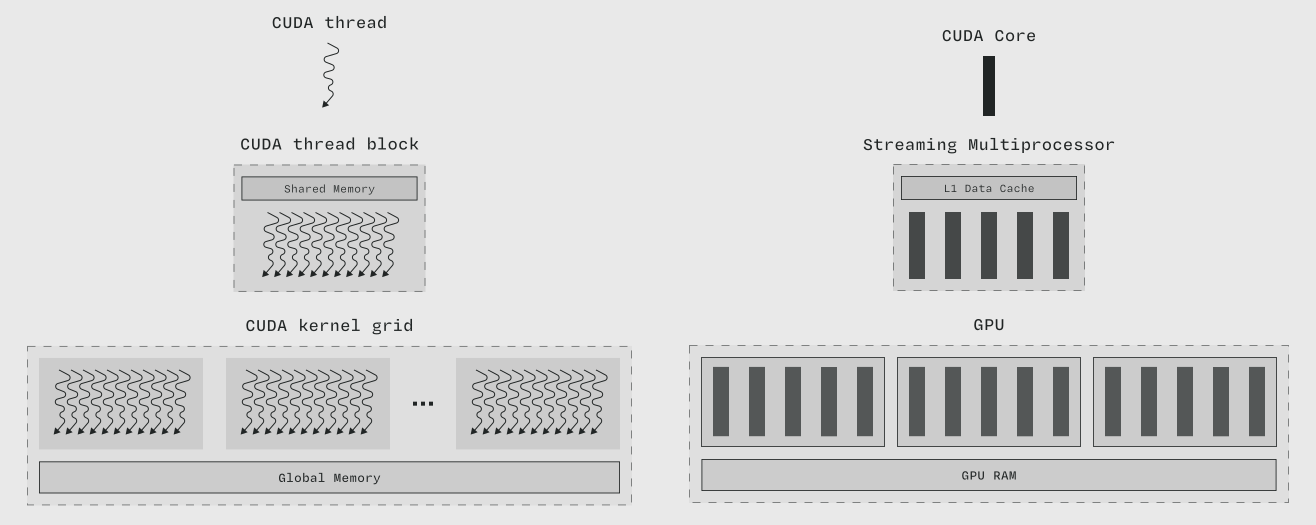
单个内核启动对应于 CUDA 编程模型 中的 线程块网格。改编自 NVIDIA 的 CUDA Refresher: The CUDA Programming Model 和 NVIDIA CUDA C++ Programming Guide 中的图表。
内核(Kernel)是程序员通常编写和组合的 CUDA 代码单元,类似于面向 CPU 的编程语言中的过程或函数。
与过程不同,内核被调用("启动")一次并返回一次,但会被执行多次--每个 线程 执行一次。这些执行通常是并发的(执行顺序不确定)且并行的(在不同的执行单元上同时发生)。
执行内核的所有线程集合被组织为内核网格——也称为 线程块网格,这是 CUDA 编程模型 中 线程层次结构 中的最高级别。内核网格在多个 流式多处理器 (SM) 间执行,因此其操作规模覆盖整个 GPU。与之对应的 内存层次结构 级别是 全局内存。
在 CUDA C++ 中,内核由主机(host)调用时会接收指向设备(device) 全局内存 的指针,且不返回任何值——它们仅对内存进行修改存。
为了让你对 CUDA 内核编程有初步了解,让我们来看两个 CUDA 内核实现"hello world"的例子:两个矩阵 A 和 B 的矩阵乘法。这两种实现的区别在于如何将经典矩阵乘法算法映射到 线程层次结构 和 内存层次结构 上。
其中最简单的实现灵感来自于 Programming Massively Parallel Processors(第 4 版,图 3.11)中首个矩阵乘法内核的启发,每个 线程 负责计算输出矩阵的一个元素——依次将 A 的特定 row 行和 B 的特定 col 列的元素加载到 寄存器 中,将成对元素相乘后累加结果,并将总和放回 全局内存。
__global__ void mm(float* A, float* B, float* C, int N) {
    int row = blockIdx.y * blockDim.y + threadIdx.y;
    int col = blockIdx.x * blockDim.x + threadIdx.x;

    if (row < N && col < N) {
        float sum = 0.0f;
        for (int k = 0; k < N; k++) {
            sum += A[row * N + k] * B[k * N + col];
        }
        C[row * N + col] = sum;
    }
}
在这个内核中,每个 线程 每次从 全局内存 读取时执行一次浮点运算 (FLOP):包含一次乘法和一次加法;对应从矩阵 A 和矩阵 B 各加载一次数据。这种方式无法 充分利用整个 GPU 的性能,因为 CUDA 核心 的 算术带宽 (以 FLOPs/s 为单位) 远高于 GPU 内存 和 SM 之间的 内存带宽。
我们可以通过更精细地将算法任务映射到 线程层次结构 和 内存层次结构 上来提高 浮点运算与内存操作的比例。在下面的 "分块 (tiled)" 矩阵乘法内核中,灵感来自 Programming Massively Parallel Processors 第 4 版图 5.9,我们将矩阵 A 和 B 的子矩阵的加载操作以及矩阵 C 的子矩阵的计算操作分别映射到 共享内存 和 线程块 上。
#define TILE_WIDTH 16

__global__ void mm(float* A, float* B, float* C, int N) {

    // 在共享内存中声明变量
    __shared__ float As[TILE_WIDTH][TILE_WIDTH];
    __shared__ float Bs[TILE_WIDTH][TILE_WIDTH];

    int row = blockIdx.y * TILE_WIDTH + threadIdx.y;
    int col = blockIdx.x * TILE_WIDTH + threadIdx.x;

    float c_output = 0;
    for (int m = 0; m < N/TILE_WIDTH; ++m) {

        // 每个线程从全局内存加载 A 的一个元素和 B 的一个元素到共享内存
        As[threadIdx.y][threadIdx.x] = A[row * N + (m * TILE_WIDTH + threadIdx.x)];
        Bs[threadIdx.y][threadIdx.x] = B[(m * TILE_WIDTH + threadIdx.y) * N + col];

        // 我们等待 16x16 块中的所有线程完成加载到共享内存
        // 这样它就包含两个 16x16 的块
        __syncthreads();

        // 然后我们遍历内部维度,
        // 每次从全局内存加载一对数据时执行 16 次乘法和 16 次加法
        for (int k = 0; k < TILE_WIDTH; ++k) {
            c_output += As[threadIdx.y][k] * Bs[k][threadIdx.x];
        }
        // 在所有线程开始将下一个块加载到共享内存之前,
        // 等待所有线程完成计算
        __syncthreads();
    }
    C[row * N + col] = c_output;
}
在外层循环的每次迭代中(该迭代会加载两个元素),线程会执行16次内层循环——每次内层循环包含一次乘法和一次加法运算,因此每次全局内存读取可对应16次浮点运算(FLOPs)。
不过,这距离完全优化的矩阵乘法内核仍有差距。Anthropic 的 Si Boehm 的这篇工作日志 详细介绍了进一步优化方法,这些优化能进一步提高浮点运算与内存读取的比率,并让算法与硬件特性更紧密地匹配。我们目前讨论的内核类似于他文中的 Kernel 1 和 Kernel 3,而该工作记录共涵盖了十种内核优化方案。
需要注意的是,该工作记录和本文均只讨论在 CUDA 核心 上执行的内核编写。实际上,速度最快的矩阵乘法内核运行在 张量核心 上,后者具有更高的 算术带宽。
英文原文(Modal GPU Glossary)
in the CUDA programming model. Modified from diagrams in NVIDIA's CUDA Refresher: The CUDA Programming Model and the NVIDIA CUDA C++ Programming Guide.](themed-image://cuda-programming-model.svg)
A kernel is the unit of CUDA code that programmers typically write and compose, akin to a procedure or function in languages targeting CPUs.
Unlike procedures, a kernel is called ("launched") once and returns once, but is executed many times, once each by a number of threads. These executions are generally concurrent (their execution order is non-deterministic) and parallel (they occur simultaneously on different execution units).
The collection of all threads executing a kernel is organized as a kernel grid — aka a thread block grid, the highest level of the CUDA programming model's thread hierarchy. A kernel grid executes across multiple Streaming Multiprocessors (SMs) and so operates at the scale of the entire GPU. The matching level of the memory hierarchy is the global memory.
In CUDA C++, kernels are passed pointers to global memory on the device when they are invoked by the host and return nothing — they just mutate memory.
To give a flavor for CUDA kernel programming, let's walk through two implementations of the "hello world" of CUDA kernels: matrix multiplication of two square matrices, A and B. The two implementations will differ in how they map the textbook matrix multiplication algorithm onto the thread hierarchy and memory hierarchy.
In the simplest implementation, inspired by the first matmul kernel in Programming Massively Parallel Processors (4th edition, Figure 3.11), each thread does all of the work to compute one element of the output matrix -- loading in turn each element of a particular row of A and a particular column of B into registers, multiplying the paired elements, summing the results, and placing the sum back in global memory.
__global__ void mm(float* A, float* B, float* C, int N) {
    int row = blockIdx.y * blockDim.y + threadIdx.y;
    int col = blockIdx.x * blockDim.x + threadIdx.x;

    if (row < N && col < N) {
        float sum = 0.0f;
        for (int k = 0; k < N; k++) {
            sum += A[row * N + k] * B[k * N + col];
        }
        C[row * N + col] = sum;
    }
}
In this kernel, each thread does one floating point operation (FLOP) per read from global memory: a multiply and an add; a load from A and a load from B. You'll never use the whole GPU that way, since the arithmetic bandwidth of the CUDA Cores in FLOPs/s is much higher than the memory bandwidth between the GPU RAM and the SMs.
We can increase the ratio of FLOPs to memory operations by more carefully mapping the work in this algorithm onto the thread hierarchy and memory hierarchy. In the "tiled" matmul kernel below, inspired by that in Figure 5.9 of the 4th edition of Programming Massively Parallel Processors, we map the loading of submatrices of A and B and the computation of submatrices of C onto shared memory and thread blocks respectively.
#define TILE_WIDTH 16

__global__ void mm(float* A, float* B, float* C, int N) {

    // declare variables in shared memory ("smem")
    __shared__ float As[TILE_WIDTH][TILE_WIDTH];
    __shared__ float Bs[TILE_WIDTH][TILE_WIDTH];

    int row = blockIdx.y * TILE_WIDTH + threadIdx.y;
    int col = blockIdx.x * TILE_WIDTH + threadIdx.x;

    float c_output = 0;
    for (int m = 0; m < N/TILE_WIDTH; ++m) {

        // each thread loads one element of A and one of B from global memory into smem
        As[threadIdx.y][threadIdx.x] = A[row * N + (m * TILE_WIDTH + threadIdx.x)];
        Bs[threadIdx.y][threadIdx.x] = B[(m * TILE_WIDTH + threadIdx.y) * N + col];

        // we wait until all threads in the 16x16 block are done loading into smem
        // so that it contains two 16x16 tiles
        __syncthreads();

        // then we loop over the inner dimension,
        // performing 16 multiplies and 16 adds per pair of loads from global memory
        for (int k = 0; k < TILE_WIDTH; ++k) {
            c_output += As[threadIdx.y][k] * Bs[k][threadIdx.x];
        }
        // wait for all threads to finish computing
        // before any start loading the next tile into smem
        __syncthreads();
    }
    C[row * N + col] = c_output;
}
For each iteration of the outer loop, which loads two elements, a thread runs 16 iterations of the inner loop, which does a multiply and an add, for 16 FLOPs per global memory read.
This is still far from a fully optimized kernel for matrix multiplication. This worklog by Si Boehm of Anthropic walks through optimizations that further increase the FLOP to memory read ratio and map the algorithm even more tightly onto the hardware. Our kernels resemble his Kernel 1 and Kernel 3; the worklog covers ten kernels.
That worklog and this article only consider writing kernels for execution on the CUDA Cores. The absolute fastest matrix multiplication kernels run instead on Tensor Cores, which have a much higher arithmetic bandwidth.
相关词条
本词条改编自 Modal GPU Glossary(CC BY 4.0)· 中文翻译 miter6/gpu-glossary-zh,MAE 整理排版。