算术强度arithmetic intensity
算术强度是 内核 (kernel) 中算术操作与内存操作的比率。
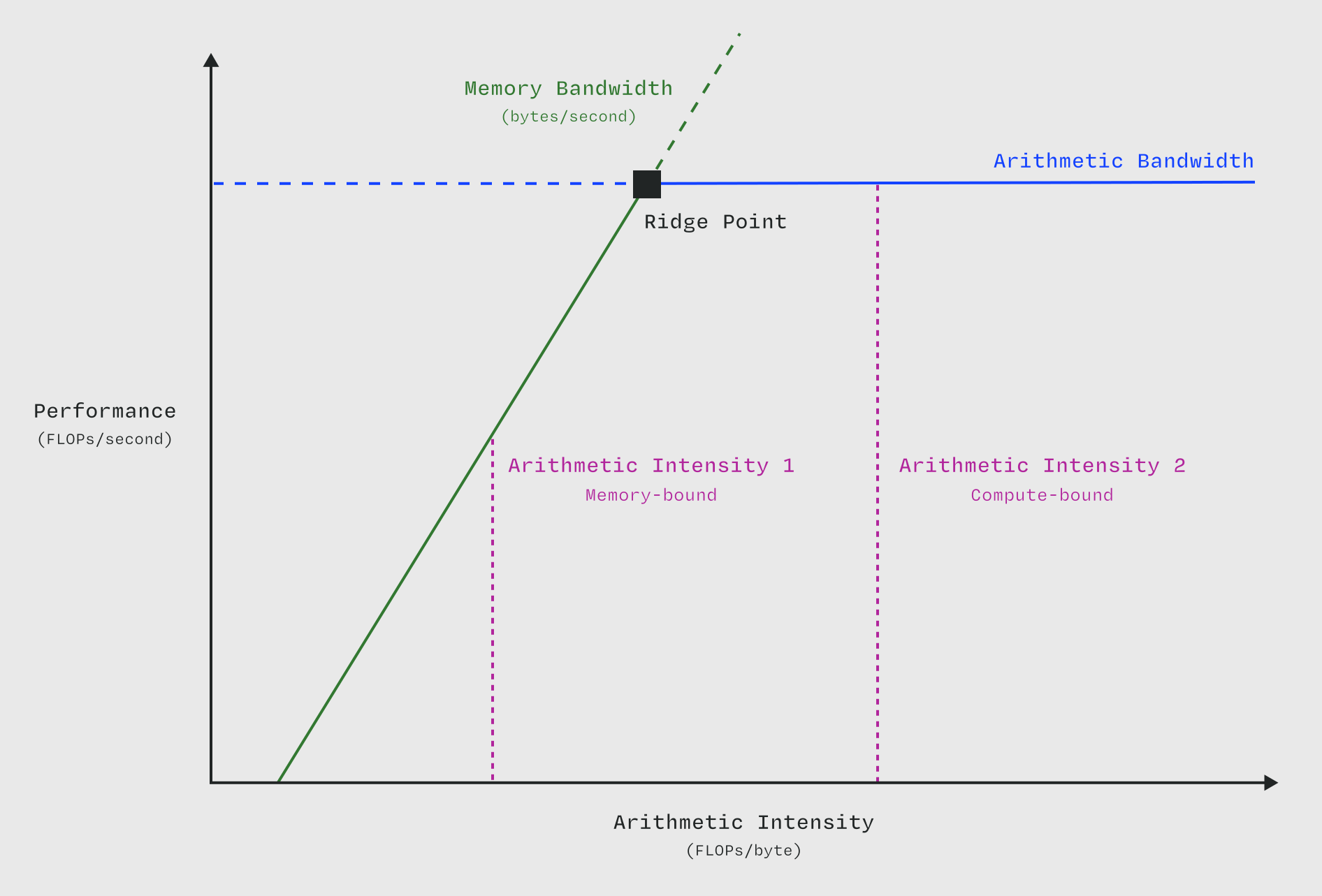
在 屋顶线模型 (roofline model) 中,操作/算术强度绘制在横轴上。图表改编自 Williams, Waterman, and Patterson (2008)。
高算术强度意味着一个 内核 (kernel) 每加载一个字节会执行许多算术操作。由于现代 GPU 中 算术带宽 (arithmetic bandwidth) 与 内存带宽 (memory bandwidth) 之间的高比率,最高效的内核具有高算术强度。这意味着当缓解内存 瓶颈 (bottleneck) 时,我们往往可以将工作从内存子系统转移到计算子系统,从而节省 内存带宽 (memory bandwidth) ,但会增加算术单元的负载。
例如,压缩 全局内存 (global memory) 中的数据可以减少内存流量,因为需要传输的字节数更少,但计算单元必须执行额外的解压缩操作。如果我们之前受限于内存 瓶颈 (bottleneck),这种方法可以提升性能,同时也会提高浮点运算与搬运字节数的比率,即增加算术强度。
再举一个例子,反向传播算法 会产生长期存在的中间变量(激活值),这些中间变量通常必须在正向传播期间存储在 全局内存 (global memory) 中,然后在反向传播时重新读取。在某些情况下,只存储部分中间变量并重新计算其余部分(一种称为 梯度检查点 (gradient checkpointing) 的技术)会更快,这也能提高算术强度。
由于不同算法本质上具有不同的操作复杂度和内存复杂度,所以它们在算术强度上的扩展方式也固有地不同。一个具有 O(1) 操作复杂度和 O(N) 内存复杂度的算法具有 O(1/N) 的算术强度扩展,而一个具有 O(N) 操作复杂度和 O(1) 内存复杂度的算法具有 O(N) 的算术强度扩展。
| 内核 (Kernel) | FLOPs | 移动字节数<br> (Bytes Moved) | 算术强度<br> (Arithmetic Intensity) | 算术强度扩展<br> (Arithmetic Intensity Scaling) |
|---|---|---|---|---|
| SAXPY y = ax + y | 2N | 12N | 1/6 | O(1) |
| 单精度实数 FFT (Single-Precision Real FFT) | 5/2 N log(N) | 16N | 5/32 log(N) | O(log(N)) |
| SGEMM C = A @ B + C | 2N^3 | 16N^2 | N/8 | O(N) |
值得注意的是,矩阵乘法的算术强度呈线性缩放,即 O(N) —— 其操作复杂度为 O(N³),内存复杂度为 O(N²)。这种有利的缩放特性使得矩阵乘法相关应用能够轻松适配以算术强度为导向的硬件(参见 关于屋顶线建模的文章 中的讨论)。这是过去几十年,基于矩阵乘法的机器学习算法(如神经网络)成功的关键秘诀之一。
关于算术强度在 Transformer 神经网络中使用的 Bahdanau 注意力机制中的应用讨论,请参阅 Zadouri、Strauss 和 Dao 的 这篇论文。
要使工作达到 计算受限 (compute-bound)(即超过 屋顶线模型 (roofline model) 的脊点)所需的最小算术强度是系统的一个固定参数,因此只需推导一次。以下表格列出了近期NVIDIA数据中心GPU的脊点算术强度。请注意,从 Ampere 到 Hopper 再到 Blackwell 流式多处理器架构 (Streaming Multiprocessor architectures),最高脊点已经增加。
| 系统 (计算/内存)<br> (System (Compute/Memory)) | 算术带宽 (Arithmetic Bandwidth) <br>(TFLOPs/s) | 内存带宽 (Memory Bandwidth) <br>(TB/s) | 脊点 (Ridge Point) <br>(FLOPs/byte) |
|---|---|---|---|
| A100 80GB SXM BF16 TC / HBM2e | 312 | 2 | 156 |
| H100 SXM BF16 TC / HBM3 | 989 | 3.35 | 295 |
| B200 BF16 TC / HBM3e | 2250 | 8 | 281 |
| H100 SXM FP8 TC / HBM3 | 1979 | 3.35 | 592 |
| B200 FP8 TC / HBM3e | 4500 | 8 | 562 |
| B200 FP4 TC / HBM3e | 9000 | 8 | 1125 |
英文原文(Modal GPU Glossary)
Arithmetic intensity is the ratio of arithmetic operations to memory operations in a kernel.
, operational/arithmetic intensity is plotted on the horizontal axis. Diagram adapted from Williams, Waterman, and Patterson (2008).](themed-image://roofline-model.svg)
A high arithmetic intensity indicates that a kernel performs many arithmetic operations per byte loaded. Due to the high ratio between arithmetic bandwidth and memory bandwidth in modern GPUs, the most efficient kernels have high arithmetic intensity. That means that when elevating a memory bottleneck, we can often shift work from the memory subsystem to the compute subsystem, saving on memory bandwidth but adding to the load on the arithmetic units.
For example, compressing data in global memory reduces memory traffic since fewer bytes need to be transferred, but the compute units must perform additional decompression operations. If we were previously bottlenecked by memory, this can improve performance. It also increases the ratio of FLOPs to bytes moved, increasing the arithmetic intensity.
As another example, the backpropagation algorithm creates long-lived intermediates (activation values) that generally must be stored in global memory during a forward pass and then retrieved during a backwards pass. In some cases, it is faster to store only a fraction of these intermediates and then recompute the remainder (a technique known as gradient checkpointing), which increases arithmetic intensity.
Because different algorithms inherently have different operational and memory complexities, they inherently scale differently in arithmetic intensity. An algorithm with O(1) operational complexity and O(N) memory complexity has O(1/N) arithmetic intensity scaling, while one with O(N) operational complexity and O(1) memory complexity has O(N) arithmetic intensity scaling.
| Kernel | FLOPs | Bytes Moved | Arithmetic Intensity | Arithmetic Intensity Scaling |
|---|---|---|---|---|
| SAXPY y = ax + y | 2N | 12N | 1/6 | O(1) |
| Single-Precision Real FFT | 5/2 N log(N) | 16N | 5/32 log(N) | O(log(N)) |
| SGEMM C = A @ B + C | 2N^3 | 16N^2 | N/8 | O(N) |
Notably, matrix multiplication scales linearly, i.e. is O(N), in arithmetic intensity — it is O(N^3) in operational complexity and O(N^2) in memory complexity. This favorable scaling makes it easy to map applications of matrix multiplication onto arithmetic-intensity-oriented hardware (see discussion in the article on roofline modeling). It is a key secret to the success of machine learning algorithms based on matrix multiplication, like neural networks, in the past few decades.
For a discussion of arithmetic intensity as applied to Bahdanau attention, used in Transformer neural networks, see this paper by Zadouri, Strauss, and Dao.
The minimum arithmetic intensity required for work to be compute-bound (that is, to be past the ridge point of the roofline model) is a fixed parameter of a system and so only needs to be derived once. Ridge point arithmetic intensities for recent NVIDIA data center GPUs appear in the table below. Notice that the highest ridge point has increased going from the Ampere to Hopper to Blackwell Streaming Multiprocessor architectures.
| System (Compute / Memory) | Arithmetic Bandwidth (TFLOPs/s) | Memory Bandwidth (TB/s) | Ridge Point (FLOPs/byte) |
|---|---|---|---|
| A100 80GB SXM BF16 TC / HBM2e | 312 | 2 | 156 |
| H100 SXM BF16 TC / HBM3 | 989 | 3.35 | 295 |
| B200 BF16 TC / HBM3e | 2250 | 8 | 281 |
| H100 SXM FP8 TC / HBM3 | 1979 | 3.35 | 592 |
| B200 FP8 TC / HBM3e | 4500 | 8 | 562 |
| B200 FP4 TC / HBM3e | 9000 | 8 | 1125 |
相关词条
本词条改编自 Modal GPU Glossary(CC BY 4.0)· 中文翻译 miter6/gpu-glossary-zh,MAE 整理排版。