占用率occupancy
占用率(Occupancy)是指设备上 活跃线程束 数量与最大 活跃线程束 数量的比值。
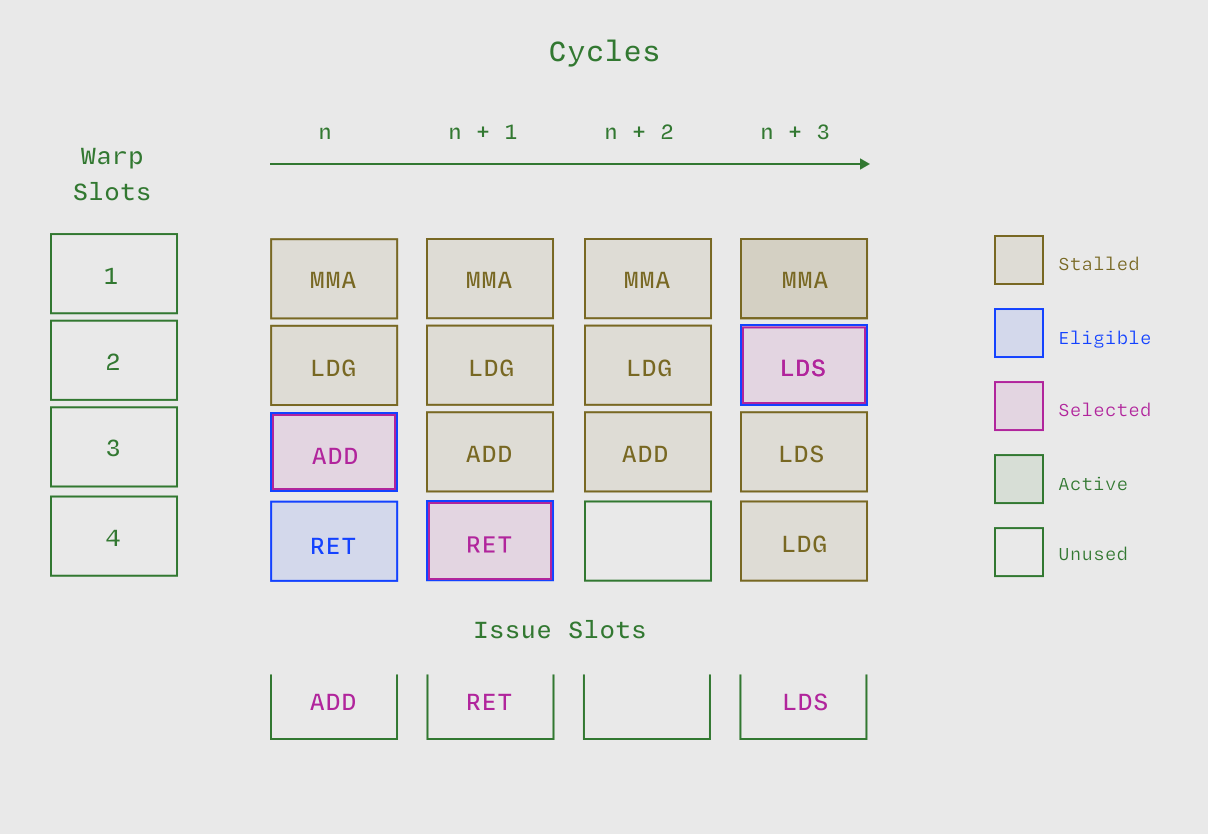
每个周期有4个线程束槽位,共4个时钟周期,因此总共有16(4×4)个线程束槽位,其中15个槽位存在活跃线程束,占用率约为94%。图表灵感来自GTC 2025的 *CUDA Techniques to Maximize Compute and Instruction Throughput* 演讲。
占用率测量有两种类型:
作为 CUDA编程模型 的一部分,线程块 中的所有 线程 都被调度到同一个 流式多处理器 (SM) 上。每个 SM 都有资源(如 共享内存 中的空间),这些资源必须在 线程块 之间进行分配,因此限制了可以在 SM 上调度的 线程块 数量。
让我们来看一个例子。考虑 NVIDIA H100 GPU,它具有以下规格:
最大线程束/SM:64
最大块/SM:32
(32位)寄存器:65536
共享内存:228 KB
对于一个每 线程块 32 个 线程、每 线程 8 个 寄存器 和每 线程块 12 KB 共享内存 的 内核,我们最终会受到 共享内存 的限制:
64 > 1   = warps/block = 32 threads/block ÷ 32 threads/warp
32 < 256 = blocks/register-file = 65,536 registers/register-file ÷ (32 threads/block × 8 registers/thread)
32       = blocks/SM
19       = blocks/smem = 228 KB/smem ÷ 12 KB/block
尽管 寄存器文件 足够大,可以同时支持 256 个 线程块,但 共享内存 却不够,因此每个 SM 只能运行 19 个 线程块,对应 19 个线程束。这种情况很常见,存储在 寄存器 中的程序中间结果的大小,远小于需要保留在 共享内存 中的程序 工作集 元素的大小。
当没有足够的 就绪线程束 来 隐藏指令延迟 时,低占用率会损害性能,具体表现为指令 发射效率 低和 流水线利用率不足。然而,一旦占用率足以进行 延迟隐藏,进一步增加占用率实际上可能会降低性能。更高的占用率会减少每个 线程 的资源,可能导致 内核在寄存器上出现瓶颈 或者降低现代GPU架构旨在利用的 算术强度。
更一般地说,占用率衡量的是 GPU 同时处理其最大并行任务的比例,这在大多数内核中并非优化的固有目标。相反,如果是 计算受限,我们希望最大化计算资源的 利用率;如果是 内存受限,我们希望最大化内存资源的利用率。
特别是,在 Hopper 和 Blackwell 架构 的 GPU 上,高性能 GEMM 内核通常以个位数的百分比占用率运行,因为它们不需要太多的 线程束 就能使 张量核心 完全饱和。
英文原文(Modal GPU Glossary)
Occupancy is the ratio of the active warps to the maximum number of active warps on a device.
talk at GTC 2025.](themed-image://cycles.svg)
There are two types of occupancy measurements:
- _Theoretical Occupancy_ represents the upper limit for occupancy due to the
- kernel launch configuration and device capabilities.
- _Achieved Occupancy_ measures the actual occupancy during
- kernel execution, aka on
- active cycles.
As part of the CUDA programming model, all the threads in a thread block are scheduled onto the same Streaming Multiprocessor (SM). Each SM has resources (like space in shared memory) that must be partitioned across thread blocks and so limit the number of thread blocks that can be scheduled on the SM.
Let's work through an example. Consider an NVIDIA H100 GPU, which has these specifications:
Maximum warps/SM: 64
Maximum blocks/SM: 32
(32 bit) Registers: 65536
Shared memory (smem): 228 KB
For a kernel using 32 threads per thread block, 8 registers per thread, and 12 KB shared memory per thread block, we end up limited by shared memory:
64 > 1   = warps/block = 32 threads/block ÷ 32 threads/warp
32 < 256 = blocks/register-file = 65,536 registers/register-file ÷ (32 threads/block × 8 registers/thread)
32       = blocks/SM
19       = blocks/smem = 228 KB/smem ÷ 12 KB/block
Even though our register file is big enough to support 256 thread blocks concurrently, our shared memory is not, and so we can only run 19 thread blocks per SM, corresponding to 19 warps. This is the common case where the size of program intermediates stored in registers is much smaller than elements of the program's working set that need to stay in shared memory.
Low occupancy can hurt performance when there aren't enough eligible warps to hide the latency of instructions, which shows up as low instruction issue efficiency and under-utilized pipes. However, once occupancy is sufficient for latency hiding, increasing it further may actually degrade performance. Higher occupancy reduces resources per thread, potentially bottlenecking the kernel on registers or reducing the arithmetic intensity that modern GPU architectures are designed to exploit.
More generally, occupancy measures what fraction of its maximum parallel tasks the GPU is handling simultaneously, which is not inherently a target of optimization in most kernels. Instead, we want to maximize the utilization of compute resources if we are compute-bound or memory resources if we are memory-bound.
In particular, high-performance GEMM kernels on Hopper and Blackwell architecture GPUs often run at single-digit occupancy percentages because they don't need many warps to fully saturate the Tensor Cores.
相关词条
本词条改编自 Modal GPU Glossary(CC BY 4.0)· 中文翻译 miter6/gpu-glossary-zh,MAE 整理排版。