并行线程执行Parallel Thread Execution
并行线程执行 (Parallel Thread eXecution, PTX) 是一种用于在并行处理器(几乎都是 NVIDIA GPU)的中间表示 (intermediate representation, IR) 代码。它是 nvcc(NVIDIA CUDA 编译器驱动程序)输出的格式之一。许多 NVIDIA 工程师将其发音为 "pee-tecks",而其他人则发音为 "pee-tee-ecks"。
NVIDIA 文档将 PTX 同时称为"虚拟机"和"指令集架构"。
从程序员的角度来看,PTX 是一种面向虚拟机模型编程的指令集。生成 PTX 的程序员或编译器可以确信,他们的程序将在许多不同的物理机器 (包括尚不存在的机器) 上以相同的语义运行。从这种角度看,它也类似于 CPU 指令集架构,如 x86_64、aarch64 或 SPARC。
与这些 ISA 不同的是,PTX 更像是一种 中间表示,类似于 LLVM-IR。CUDA 二进制文件 中的 PTX 组件将由主机 CUDA 驱动程序 即时编译 (just-in-time, JIT) 为特定设备的 SASS 以供执行。
对于 NVIDIA GPU 而言,PTX 是前向兼容的:由于这种 JIT 编译机制,计算能力 (compute capability) 版本匹配或更高的 GPU 将能够运行该程序。通过这种方式,PTX 成为了连接硬件和软件世界的 ["窄腰"] 层(https://www.oilshell.org/blog/2022/02/diagrams.html)。
一些 PTX 示例:
.reg .f32 %f<7>;- 用于 PTX-to-SASS SASS 编译器的汇编指令,表明该内核 (kernel) 使用七个 32 位浮点 寄存器 (registers)。寄存器是从 流式多处理器 (Streaming Multiprocessor, SM) 的 寄存器文件 (register file) 中动态分配给 线程 (threads) 组的(线程束 (warps))。
fma.rn.f32 %f5, %f4, %f3, 0f3FC00000;- 将寄存器
f3和f4的内容执行融合乘加 (fma) 操作,并加上常量0f3FC00000,将结果存储在寄存器f5中。所有数字均为 32 位浮点表示。FMA 操作的rn后缀将浮点舍入模式设置为 IEEE 754 "向偶数舍入"(默认模式)。
mov.u32 %r1, %ctaid.x;
mov.u32 %r2, %ntid.x;
mov.u32 %r3, %tid.x;- 将协作线程数组索引 (cooperative thread array index) 的
x轴值、协作线程数组维度索引 (ntid) 和线程索引 (thread index) 移动到三个u32寄存器r1-r3中。
PTX 编程模型向程序员公开了多个级别的并行性。这些级别通过 PTX 机器模型直接映射到底层硬件(如下图所示)。
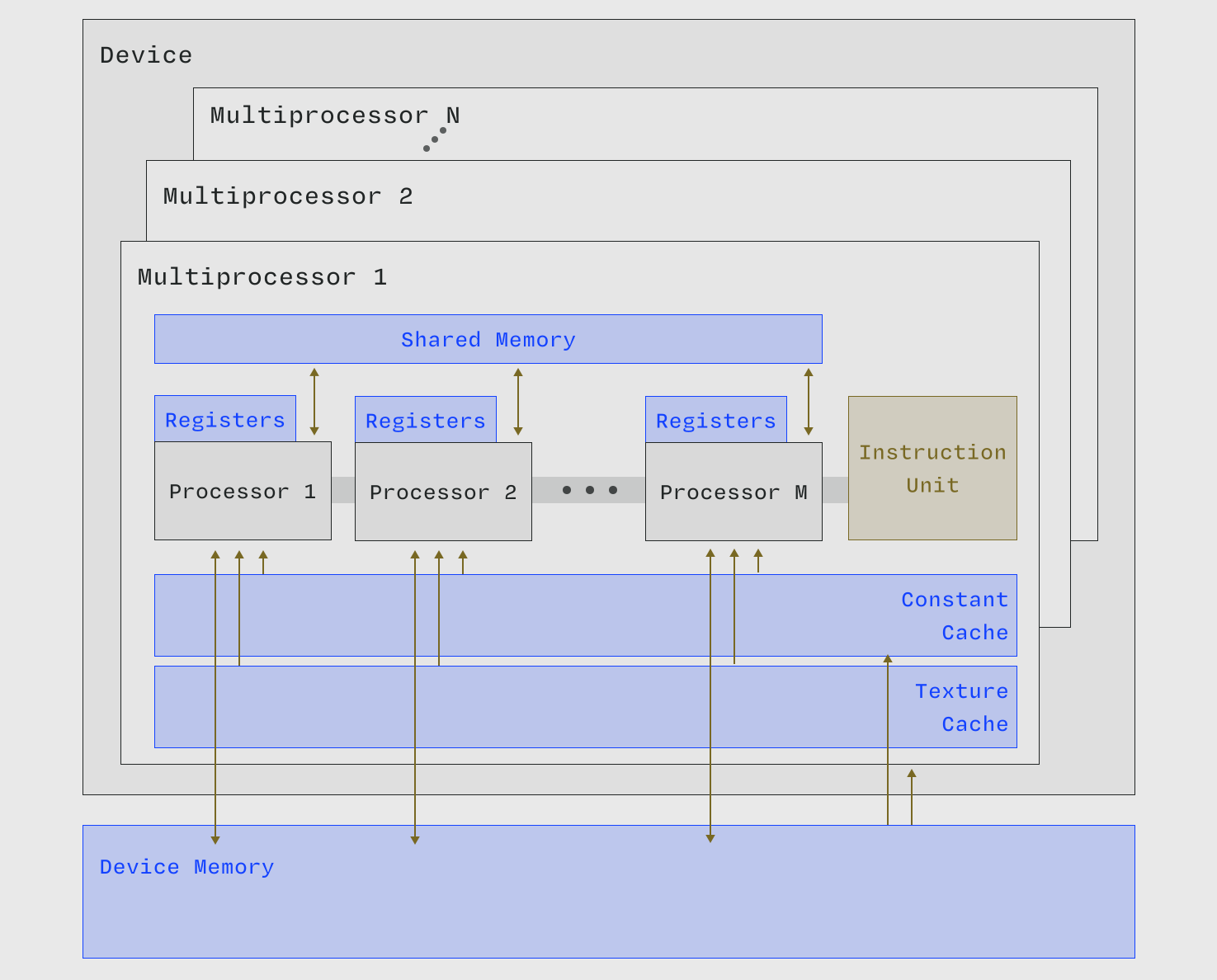
PTX 机器模型。修改自 PTX 文档。
值得注意的是,在此机器模型中,多个处理器共享一个指令单元。虽然每个处理器运行一个 线程 (thread),但这些线程必须执行相同的指令——这正是“并行线程执行”(PTX)的由来。线程之间通过 共享内存 (shared memory) 相互协调,并借助私有 寄存器 (registers) 实现不同的计算结果。
最新版本的 PTX 文档可从 NVIDIA 此处 获取。PTX 的指令集使用称为 "计算能力 (compute capability)" 的数字进行版本控制,该数字与 "最低支持的 流式多处理器架构 (Streaming Multiprocessor architecture) 版本" 同义。
与手写内联x86_64汇编类似,除了追求极致性能的场景外,手动编写内联PTX的情况并不常见——例如在分析型数据库的高性能向量查询算子或操作系统内核的性能敏感部分中。截至2025年9月,内联PTX仍是利用部分Hopper架构特有硬件特性(如wgmma和tma指令)的唯一方式,相关应用可参考论文或技术分享。Godbolt平台支持同时查看CUDA C、SASS和PTX代码,具体细节可查阅NVIDIA内联PTX汇编文档。
与手写内联 x86_64 汇编类似,除了追求极致性能的场景外,手动编写内联 PTX 的情况并不常见,例如在分析数据库中的高性能向量化查询运算符或是操作系统内核的性能敏感部分中所做的那样。截止 2025 年 9 月撰写本文时,内联 PTX 仍是利用部分 Hopper 架构特有硬件功能(如 wgmma 和 tma 指令)的唯一方式,例如 Flash Attention 3 或 Machete w4a16 内核 。在 Godbolt 平台上支持同时查看 CUDA C/C++、SASS 和 PTX 代码。详情请参阅 NVIDIA "在 CUDA 中使用内联 PTX 汇编"指南。
英文原文(Modal GPU Glossary)
Parallel Thread eXecution (PTX) is an intermediate representation (IR) for code that will run on a parallel processor (almost always an NVIDIA GPU). It is one of the formats output by nvcc, the NVIDIA CUDA Compiler Driver. It is pronounced "pee-tecks" by many NVIDIA engineers and "pee-tee-ecks" by everyone else.
NVIDIA documentation refers to PTX as both a "virtual machine" and an "instruction set architecture".
From the programmer's perspective, PTX is an instruction set for programming against a virtual machine model. Programmers or compilers producing PTX can be confident their program will run with the same semantics on many distinct physical machines, including machines that do not yet exist. In this way, it is also similar to CPU instruction set architectures like x86_64, aarch64, or SPARC.
Unlike those ISAs, PTX is very much an intermediate representation, like LLVM-IR. The PTX components of a CUDA binary will be just-in-time (JIT) compiled by the host CUDA Drivers into device-specific SASS for execution.
In the case of NVIDIA GPUs, PTX is forward-compatible: GPUs with a matching or higher compute capability version will be able to run the program, thanks to this mechanism of JIT compilation. In this way, PTX is a "narrow waist" that separates the worlds of hardware and software.
Some exemplary PTX:
.reg .f32 %f<7>;- a compiler directive for the
- PTX-to-SASS compiler
- indicating that this kernel consumes seven 32-bit floating point
- registers. Registers are
- dynamically allocated to groups of
- threads
- (warps) from the
- SM's
- register file.
fma.rn.f32 %f5, %f4, %f3, 0f3FC00000;- apply a fused multiply-add (
fma) operation to multiply the contents of - registers
f3andf4and add the constant0f3FC00000, storing the result - in
f5. All numbers are in 32 bit floating point representation. Thern - suffix for the FMA operation sets the floating point rounding mode to
- IEEE 754 "round even" (the default).
mov.u32 %r1, %ctaid.x;
mov.u32 %r2, %ntid.x;
mov.u32 %r3, %tid.x;move thex-axis values of thecooperativethreadarrayindex,- the cooperative thread array dimension index (
ntid), and thethread -
index into threeu32registersr1-r3.
The PTX programming model exposes multiple levels of parallelism to the programmer. These levels map directly onto the hardware through the PTX machine model, diagrammed below.
.](themed-image://ptx-machine-model.svg)
Notably, in this machine model there is a single instruction unit for multiple processors. While each processor runs one thread, those threads must execute the same instructions — hence _parallel_ thread execution, or PTX. They coordinate with each other through shared memory and effect different results by means of private registers.
The documentation for the latest version of PTX is available from NVIDIA here. The instruction sets of PTX are versioned with a number called the "compute capability", which is synonymous with "minimum supported Streaming Multiprocessor architecture version".
Writing in-line PTX by hand is uncommon outside of the cutting edge of performance, similar to writing in-line x86_64 assembly, as is done in high-performance vectorized query operators in analytical databases and in performance-sensitive sections of operating system kernels. At time of writing in September of 2025, in-line PTX is the only way to take advantage of some Hopper-specific hardware features like the wgmma and tma instructions, as in Flash Attention 3 or in the Machete w4a16 kernels. Viewing CUDA C/C++, SASS, and PTX together is supported on Godbolt. See the NVIDIA "Inline PTX Assembly in CUDA" guide for details.
相关词条
本词条改编自 Modal GPU Glossary(CC BY 4.0)· 中文翻译 miter6/gpu-glossary-zh,MAE 整理排版。